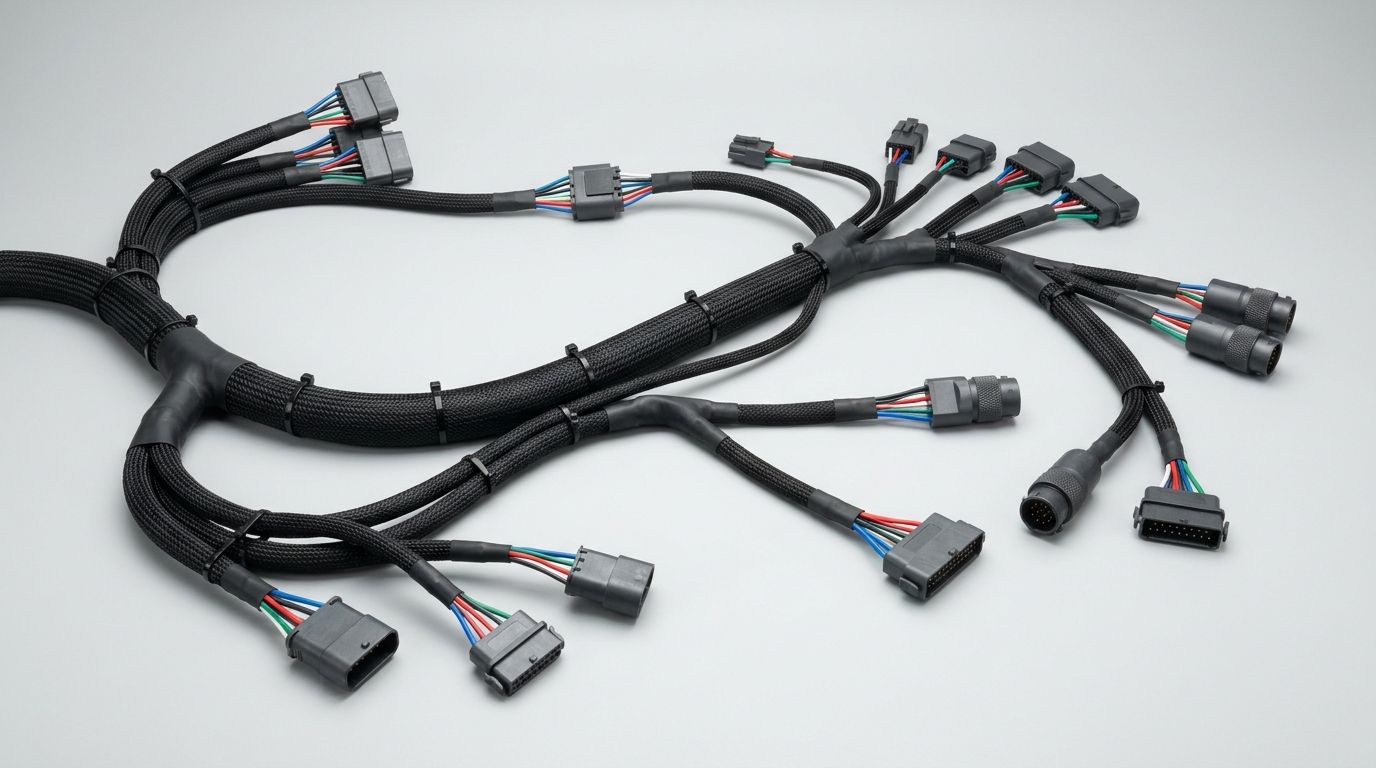
What the standard covers
The standard describes how a finished assembly has to look and measure to be accepted. Its chapters follow the steps of building one: wire stripping, soldered and crimped terminations, insulation displacement connections, ultrasonic welds, splices, connectors, overmolding, marking, coaxial cables, securing, shielding, protective coverings, installation and testing.
The current edition is revision F, published in October 2025. It replaces revision E from October 2022; the first edition appeared in January 2002. A companion standard, IPC-D-620, covers the design of cable and wire harness assemblies.
A new revision does not replace the old one in an existing customer relationship on its own: according to the publisher, that happens only when the contract requires it. Name the revision on the drawing, for example IPC/WHMA-A-620F.
Three classes, from general use to harsh environments
The classes are the general product classes that IPC uses across its standards. They reflect rising demands on sophistication, functional performance and the frequency of testing and inspection.
| Class | Official name | Intended for |
|---|---|---|
| 1 | General Electronic Products | Products where the main requirement is that the finished assembly works. |
| 2 | Dedicated Service Electronic Products | Products that need continued performance and a long service life, where uninterrupted service is desired but not critical. The end-use environment would typically not cause failures. |
| 3 | High Performance/Harsh Environment Electronic Products | Products where continued high performance or performance on demand is critical, downtime cannot be tolerated and the end-use environment may be uncommonly harsh. The equipment must work when required, for example in life support systems. |
How the class changes acceptance
For each feature of an assembly, the standard describes which conditions are acceptable, which are a process indicator and which are a defect, separately for each class. A condition that is acceptable in Class 1 can be a defect in Class 3.
- Acceptable: the condition meets the requirement of that class.
- Process indicator: the condition is not a defect and does not affect form, fit or function, but it points to a process that should be checked.
- Defect: the condition does not meet the requirement. The assembly is dispositioned, for example reworked, repaired or scrapped.
Higher classes also call for more inspection and testing, which adds effort and cost.
Choosing the class
The class is set for the finished assembly and follows from its end use: what happens if it fails, how harsh the environment is and how long it has to work without service. A complex system can combine classes, for example a Class 3 harness in equipment whose other assemblies are built to Class 2.
If the drawing names no class, it is clarified before the quotation. Cesium Dynamics builds and inspects to IPC/WHMA-A-620, with the class agreed per project.
How to state it on the drawing
One line on the drawing is enough: the standard, its revision and the class, for example “Workmanship to IPC/WHMA-A-620F, Class 2”. Requirements beyond the standard, such as additional tests, belong on the drawing as well.