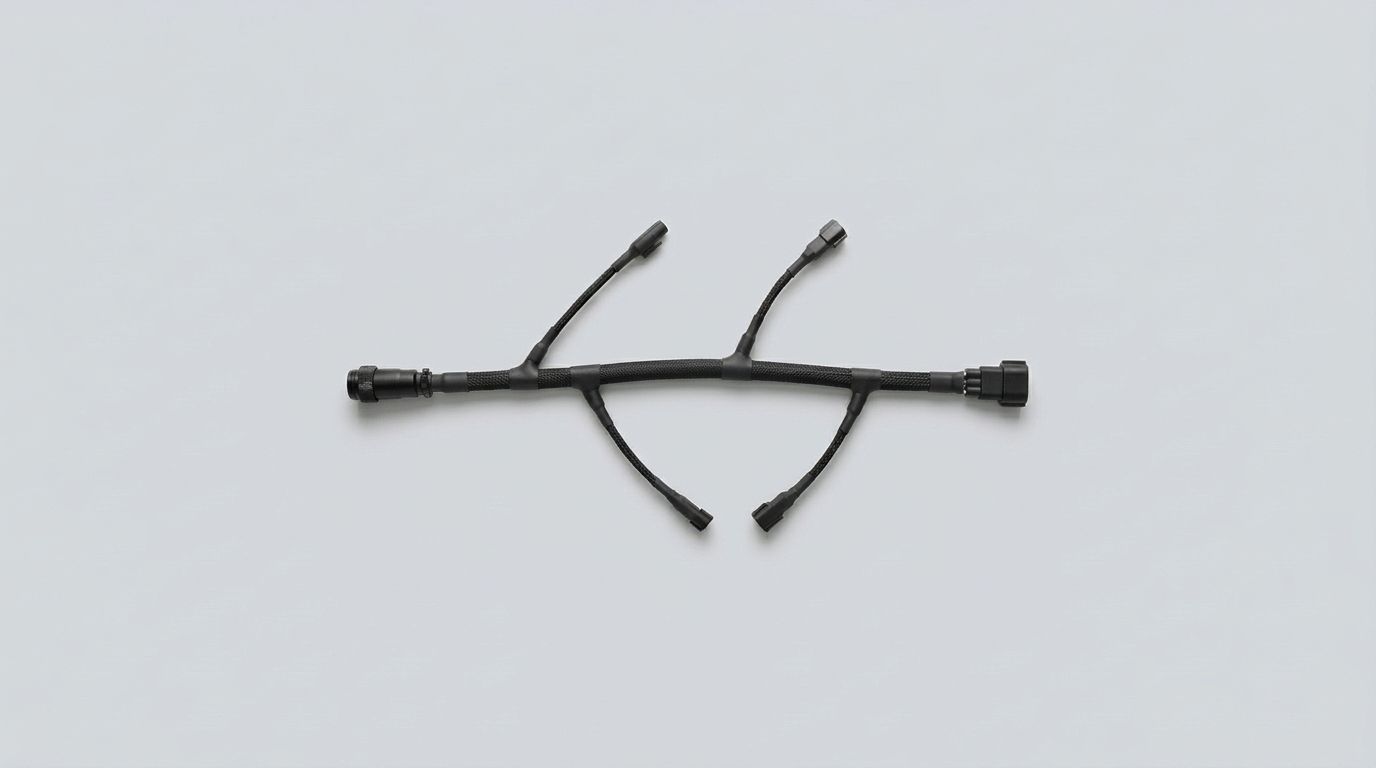
The drawing: lengths, tolerances and reference points
- Overall length and the length of every branch in millimetres, each with its tolerance.
- The reference point of each length, for example the rear face of a connector housing or the centre of a breakout. Without it, the same figure can describe two different lengths.
- The position of breakouts, labels, clips and protective sleeving along the harness.
- Drawing number and revision, so that every question and every sample refers to the same version.
The wire list and pin assignment
For every wire: from which connector and cavity to which connector and cavity, the conductor cross-section in mm² or AWG, the insulation type and the colour. Shields, drain wires and twisted pairs need their own lines, including where each shield is terminated.
If your connectors are specified in AWG and your wires in mm², the AWG to mm² table shows how the sizes relate.
The bill of materials
- Connector housings, contacts, seals and accessories with the manufacturer's part number, or the connector family and pitch if connectors from our connector range may be used.
- Whether alternatives are allowed. A drawing that names one part leaves no room for substitution, so say so if equivalent parts are acceptable.
- Wire and cable types, protective materials such as braided sleeving, heat-shrink tubing or conduit, and labels.
Crimp contacts are specified for a range of conductor cross-sections and insulation diameters. When both are stated for every wire, the drawing review can confirm that each contact suits its wire.
Workmanship, tests and materials
- The IPC/WHMA-A-620 class of the assembly. The guide to the three classes explains how they differ.
- The tests you require, each with its acceptance criterion, for example a continuity test.
- Material requirements such as RoHS and REACH, and the documents you need for your own records. The guide to RoHS and REACH summarises what both regulations require.
- Labelling and packaging, if they matter for your assembly line.
Quantities and dates
State the number of samples, the expected quantity per series order and the estimated annual quantity. The price per piece depends on the batch size, so these figures make quotations comparable. Add the date by which you need samples and, if known, the planned start of series supply.
Files that open without conversion
Send the drawing as a PDF and, where available, as the native CAD file in DXF, DWG or STEP. Bills of materials and wire lists work best as spreadsheets in XLSX. The quote request form accepts exactly these formats, up to five files with 15 MB in total.
What happens with your enquiry
Every enquiry starts with a drawing review. Open points are clarified with you before the quotation, and samples are built for your approval before series supply. The four steps are described on the How we work page.