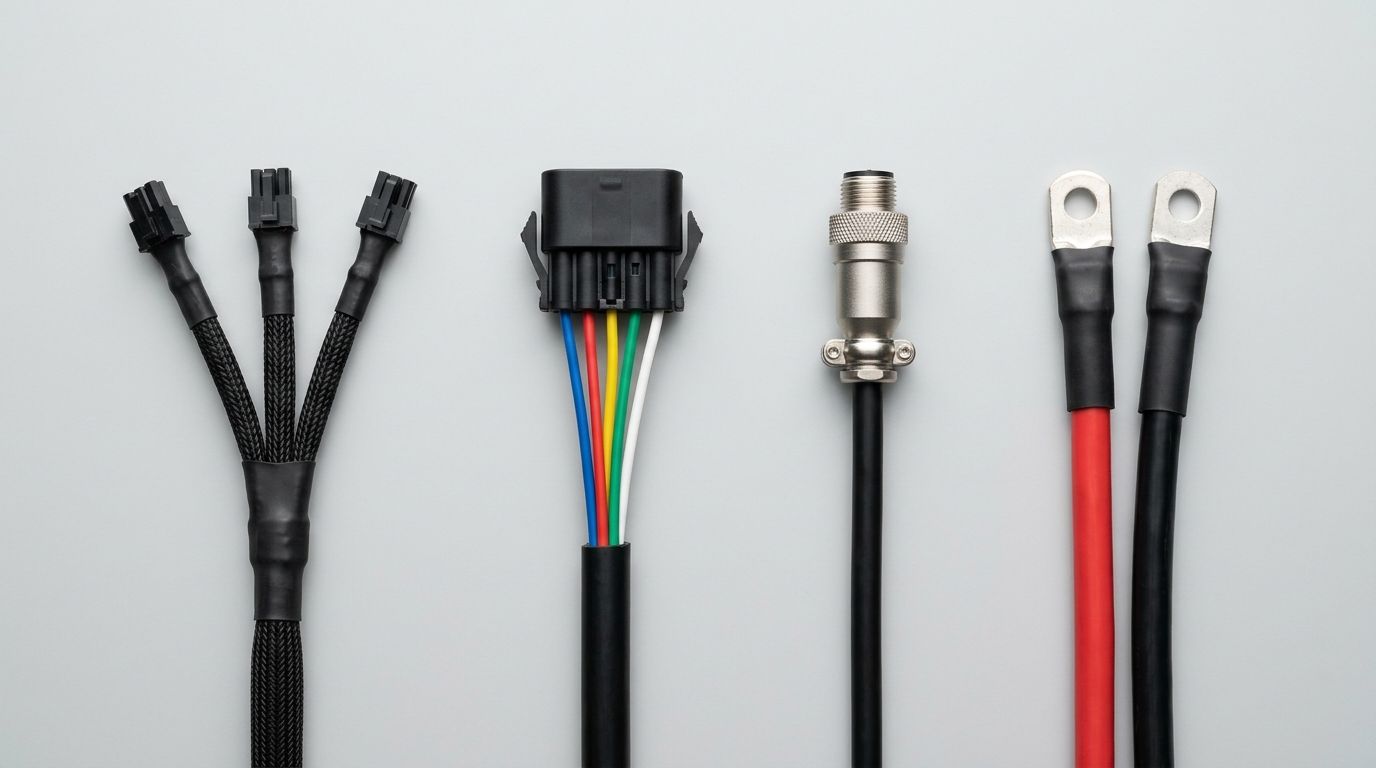
A cable assembly starts from a finished cable
The starting point is a cable: several insulated conductors under a common jacket, often with a shield. The cable is cut to length, stripped and terminated at each end with a connector, terminals or ferrules. A cable assembly usually runs point to point, from one device to another.
Typical examples are sensor leads with M8 or M12 connectors, data cables with RJ45, USB or D-sub connectors, flat ribbon cables with IDC sockets and battery leads with ring terminals.
A wire harness starts from single wires
A harness is made of individual wires. Each wire is cut, stripped and terminated, then routed along the path shown on the drawing and bundled with tape, braided sleeving or conduit. At breakouts, branches leave the main bundle towards their connectors, so one harness can connect many devices.
Because it follows the shape of the equipment, a harness is defined by its geometry: the length of every branch, the position of each breakout and the connector cavity at both ends of every wire. Typical uses are the wiring of control cabinets and machines, and sub-assemblies for vehicles.
The difference at a glance
| Feature | Cable assembly | Wire harness |
|---|---|---|
| Starting material | Finished cable with several conductors | Single wires |
| Layout | Usually point to point | Branched, with several end points |
| Protection | The cable jacket | Tape, braided sleeving or conduit, heat-shrink at breakouts |
| Defined by | Cable type, length and the two ends | Drawing with branch lengths, wire list and pin assignment |
| Typical examples | Sensor leads, data cables, ribbon cables, battery leads | Control cabinet and machine wiring, vehicle sub-assemblies |
Where the terms overlap
The line is not always sharp. A harness can contain a shielded cable as one of its branches, and a cable assembly can end in a short breakout at one end. In German the cable assembly is called Kabelkonfektion, the harness Kabelsatz or Kabelbaum.
Both are covered by the same workmanship standard, IPC/WHMA-A-620. Its three classes apply to harnesses and cable assemblies alike.
What to send for each
- For a cable assembly: the cable specification, the overall length with its tolerance, and the connector or termination at each end with its pin assignment.
- For a wire harness: a drawing with all branch lengths and breakout positions, a wire list with cross-section, colour and from–to cavity for every wire, the protection of each segment and the labels.
The enquiry checklist goes through each point in detail.